The Taj Story is a Hindi courtroom drama that turns the history of the Taj Mahal into a public debate. Instead of giving a simple love story, the film asks who built the monument, what may have stood on the land before it, and why some areas remain closed. These questions make the film interesting, but they also make it important to separate cinema, opinion, and proven history.
What Is the Film About?
The story follows Vishnu Das, a tour guide in Agra played by Paresh Rawal. He earns his living by telling visitors the accepted account of the Taj Mahal. After studying different books and claims, he begins to doubt parts of that account. He then takes his questions into a courtroom, where history becomes the subject of a legal fight.
The movie uses lawyers, witnesses, documents, and long speeches to build its case. This style allows both sides to challenge each other. It also makes the viewer feel like a member of the jury. However, a strong speech in a film is not the same as verified evidence. The courtroom scenes are written for drama, so viewers should check important claims outside the movie.
Key Film Facts, Cast, and Release
The Taj Story was certified as a Hindi UA 13+ film by India’s Central Board of Film Certification on 6 August 2025. Its certified running time is 165.29 minutes, or about two hours and 45 minutes. The certificate lists Swarnim Global Services Private Limited as the producer.
The film opened in Indian cinemas on 31 October 2025 and later reached Lionsgate Play on 13 March 2026. Paresh Rawal leads the cast as Vishnu Das. The movie is mainly known as a historical courtroom drama because its central conflict is built around questions about the Taj Mahal’s origin.
Which Questions Does the Movie Raise?
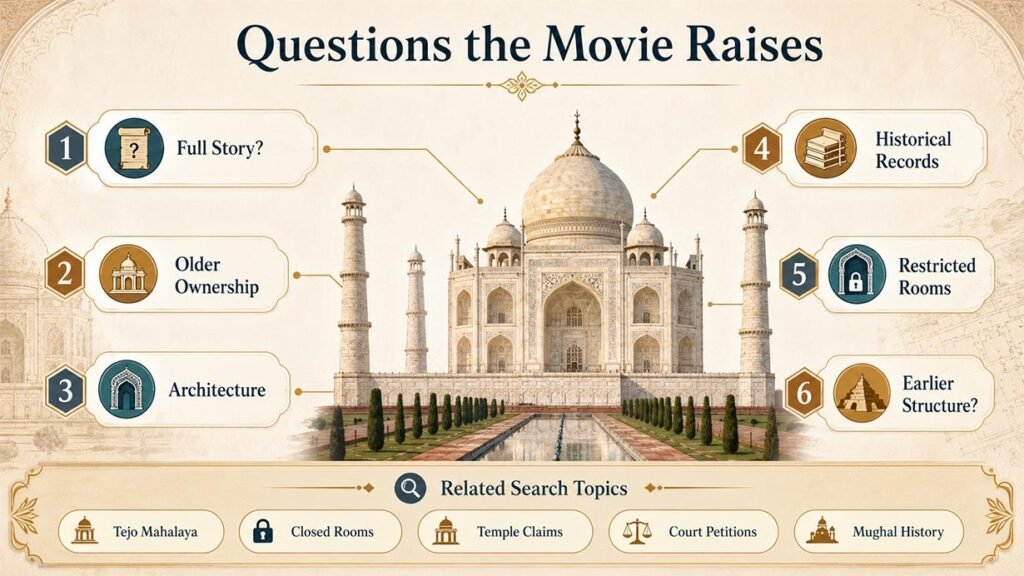
The film asks whether the public has received the full story of the monument. It looks at older ownership of the site, architectural features, historical records, and restricted rooms. It also questions whether an earlier structure existed before the Mughal project began. These points are presented as reasons to study the site and its records again.
Many online searches also connect the movie with terms such as Tejo Mahalaya, closed rooms, temple claims, court petitions, and Mughal history. These related terms may be treated as SKeywords in an SEO plan. Yet search popularity does not prove that a claim is true. It only shows what readers want to understand.
What Is the Tejo Mahalaya Claim?
One disputed theory says the Taj Mahal was once a Hindu palace or Shiva temple called Tejo Mahalaya. Supporters point to selected design features, the earlier ownership of the land, and rooms that tourists cannot enter. Different versions of the theory do not always agree, and the claim is not accepted by leading heritage authorities.
The movie gives space to doubts linked with this theory, although its public messaging has sometimes described the film as a search for facts rather than a religious argument. This difference matters. A film may say it is “asking questions,” but the order of scenes, music, dialogue, and chosen evidence can still guide the audience toward a certain view.
What Do Official Historical Sources Say?
UNESCO says Mughal emperor Shah Jahan built the Taj Mahal in memory of Mumtaz Mahal. Construction began in 1632. The main mausoleum was completed around 1648, while other parts of the complex were finished by about 1653. UNESCO describes the site as a major work of Mughal architecture.
The Archaeological Survey of India, or ASI, gives the same basic account. It identifies the monument as the peak of Mughal architecture and states that Shah Jahan built it for his queen. These official positions do not support the claim that the present monument began as a Hindu temple.
Do Closed Rooms Prove a Hidden Past?
The Taj Story gives special attention to rooms and passages that are not open to normal visitors. Closed areas naturally create curiosity. Still, protected monuments often limit access because of weak floors, narrow passages, conservation needs, security, ventilation, or the risk of damage caused by large crowds.
A closed door is therefore a question, not an answer. To prove that a hidden temple exists, researchers would need direct archaeological evidence, reliable records, careful dating, and expert review. Photos, visual similarities, or suspicion alone cannot establish the original use of a building.
How Should Historical Claims Be Tested?
Good history starts with questions, but it must continue with a clear method. Researchers compare records written near the time of an event, study original languages, inspect buildings, test materials when allowed, and check whether independent sources support the same conclusion. They must also examine evidence that may weaken their own idea.
This is where SKeywords and viral debates can mislead readers. Search engines often place popular claims beside verified facts. A useful reader checks the author, date, source, translation, and evidence behind every statement. Courtroom dialogue, social posts, and edited videos can raise interest, but they should not replace proper historical research.
Why Did the Film Create Strong Reactions?
The Taj Mahal is not only an old building. It is linked with Indian identity, tourism, religion, Mughal rule, art, and world heritage. Any claim about changing its origin can quickly become political. Some viewers saw the movie as a brave call for open research, while critics believed it gave weak theories more authority than they deserved.
Paresh Rawal said the film was not meant to create a Hindu-Muslim conflict and encouraged people to watch before judging it. Even so, public debate remained sharp because historical stories can affect how modern communities see one another.
What Viewers Should Take From the Debate
The best way to watch The Taj Story is with curiosity and care. The film can encourage people to read about the monument, study Mughal records, and learn how archaeology works. Its value is strongest when it begins research rather than ending it.
The accepted evidence still identifies the Taj Mahal as a mausoleum commissioned by Shah Jahan for Mumtaz Mahal. Alternative ideas may be discussed, but they need strong proof before they can replace that account. Viewers should respect the right to ask questions while also respecting the rules of evidence.
FAQs
Is the film based on a real court case?
The story uses real public debates and legal themes, but its courtroom plot is a dramatic screen narrative, not a complete record of one proven case.
Who plays Vishnu Das?
Paresh Rawal plays Vishnu Das, the Agra guide who questions the accepted history and brings the debate into court.
Does the movie prove the temple theory?
No. It presents questions and arguments, but it does not provide accepted proof that the Taj Mahal was originally a Hindu temple.
What do UNESCO and ASI state?
Both identify the monument as a Mughal mausoleum built by Shah Jahan in memory of Mumtaz Mahal.
Where can the film be watched?
It was released in cinemas on 31 October 2025 and later streamed on Lionsgate Play from 13 March 2026.