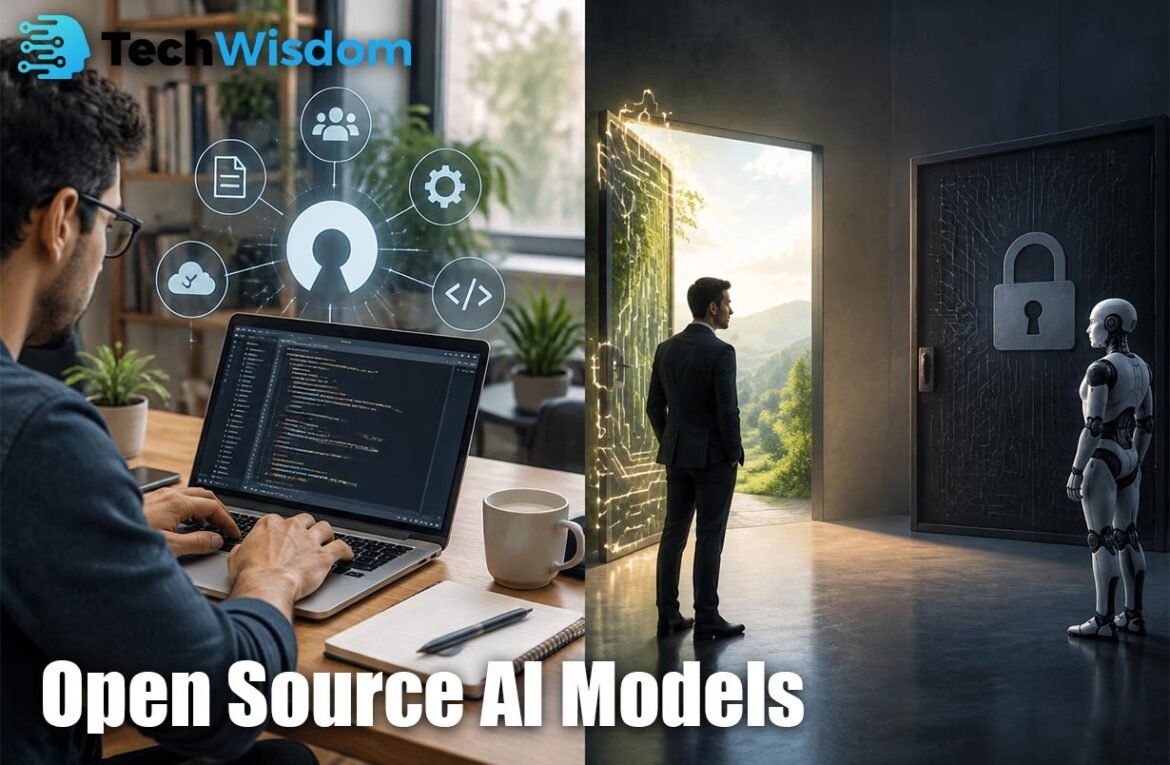
Artificial intelligence is becoming a major part of modern technology, but many advanced AI systems are controlled by large companies through closed platforms. Open Source AI Models are changing this approach by giving developers, researchers, and businesses more freedom to access, customize, and deploy powerful AI solutions. These models allow users to download model weights, improve performance through fine-tuning, and build applications without depending entirely on external providers. Popular examples include Meta Llama, Mistral, DeepSeek, Qwen, Google Gemma, and Microsoft Phi, which have expanded access to advanced AI development.
What Are Open Source AI Models and How Do They Work?
Open Source AI Models are artificial intelligence models that provide users with access to important parts of the technology, especially model weights, allowing them to run AI systems on their own infrastructure. Instead of only accessing AI through a company-owned platform, developers can download these models, adjust their behavior, and create specialized applications for different industries.
These models are usually built using large language model (LLM) technology, where systems are trained on massive datasets to understand language, generate content, answer questions, write code, and perform reasoning tasks. However, it is important to understand that many models described as “open source” are technically open-weight models, because their weights are available while training data and licensing rules may differ.
Open Source AI Models vs Closed AI Systems: Key Differences
Closed AI systems are created by companies that keep their model architecture, training process, and internal data private. Users typically access these systems through applications or APIs, which can limit customization and control.
In contrast, open models provide more flexibility. Businesses can host them internally, modify their behavior, and create solutions designed around their own requirements. For organizations working with private information, this approach can improve data control because sensitive information does not always need to be sent to external servers.
The main difference comes down to ownership and flexibility. Closed systems often provide convenience, while open models provide greater control, customization options, and independence from a single provider.
Why Developers and Businesses Are Choosing Open AI Models
One major reason behind the popularity of open models is customization. Businesses no longer need to build AI systems from the beginning. Instead, they can start with an existing model and adapt it for specific tasks such as customer support, document analysis, coding assistance, and research.
Another important advantage is privacy. Companies handling confidential information can deploy AI models on private servers instead of transferring their data to third-party platforms. This is especially valuable for industries such as healthcare, finance, legal services, and enterprise software.
Cost control is another factor driving adoption. Open Source AI Models: Large-scale AI usage through commercial APIs can become expensive, while self-hosted models allow organizations to manage infrastructure costs according to their needs.
Popular Open Source AI Models: Llama, Mistral, DeepSeek, Qwen, and More
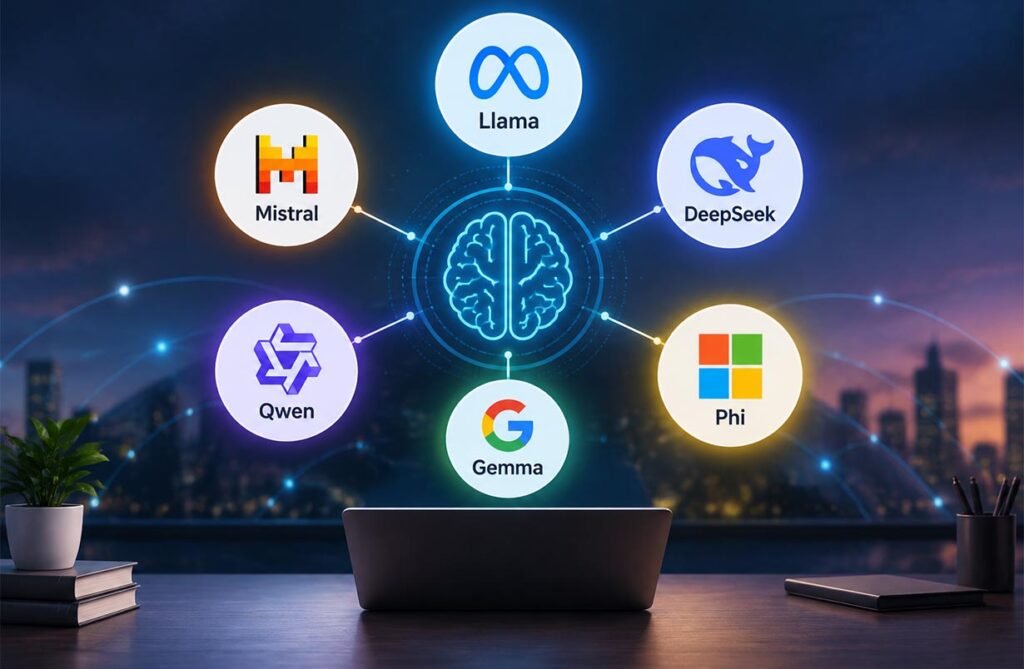
The open AI ecosystem has grown rapidly, with several models becoming widely used by developers worldwide.
Meta Llama is one of the most recognized open AI model families. It has created a large developer community and supports many applications, including chatbots, research tools, and AI assistants.
Mistral AI models are known for efficiency and strong performance with relatively lower resource requirements. Models such as Mistral 7B and Mixtral are popular among developers who want powerful AI capabilities without extremely large computing requirements.
DeepSeek gained attention for its reasoning and coding abilities. Its models have increased interest in open AI development by showing that open systems can deliver strong performance in advanced tasks.
Qwen, developed by Alibaba, focuses on multilingual understanding, coding, and general-purpose AI applications. Its different model sizes make it suitable for various hardware environments.
Google Gemma and Microsoft Phi focus on efficient AI deployment, allowing developers to experiment with smaller models that can run on less powerful hardware.
Key Features That Make Open Source AI Models Powerful
One of the biggest strengths of open models is fine-tuning. Developers can train an existing model with specialized datasets to improve its ability in specific areas. For example, a company can customize an AI assistant to understand internal documents, products, or industry terminology.
Another important feature is local deployment. Users can run models on personal computers, private servers, or cloud infrastructure. This gives organizations more control over performance, security, and costs.
Open models also support different sizes. Smaller versions can work on consumer hardware, while larger versions are designed for advanced enterprise environments. This flexibility allows developers to choose models based on their available resources and goals.
Community support is another advantage. Thousands of developers contribute tools, improvements, and integrations that help open models continue evolving.
How Companies Use Open Source AI Models in Real Applications
Businesses are using open models in many practical ways. Customer service teams use AI assistants to answer common questions and improve response times. Software companies use coding models to help developers write, review, and optimize code.
Companies also use these models for document processing, market research, internal knowledge systems, and automation. For example, an organization can create an internal AI search tool that understands company documents while keeping information private.
Researchers use open models to test new AI methods, study model behavior, and develop improvements without depending only on commercial platforms. This open research environment has helped accelerate innovation across the AI industry.
Benefits and Challenges of Using Open Source AI Models
The biggest benefits of open models include flexibility, privacy, customization, and reduced dependency on external AI providers. Businesses can modify models according to their needs and maintain greater control over their technology infrastructure.
However, open models also have challenges. Large AI models require significant computing power, especially when running advanced versions. Organizations may need expensive GPUs, technical expertise, and proper infrastructure.
Licensing is another important consideration. Not every model has the same permissions. Some allow commercial use freely, while others include specific conditions. Users should always review the license before deploying an AI model for business purposes.
Security management is also necessary because organizations must properly control access and monitor how AI systems are used.
How to Choose the Right Open Source AI Model for Your Needs
Choosing the right model depends on the specific goal. Developers working on coding projects may prefer models designed for programming tasks, while businesses needing multilingual support may choose models with broader language capabilities.
Hardware availability is another important factor. Smaller models such as Gemma or Phi may work better for local devices, while larger models like Llama, DeepSeek, or Qwen may require stronger infrastructure.
Organizations should also consider licensing, community support, update frequency, and available tools before selecting a model. The best choice is not always the largest model but the one that matches the project requirements.
The Future of Open Source AI Models in Artificial Intelligence
The future of AI development will likely include both open and closed systems. Open models continue to improve in performance, efficiency, and accessibility, allowing more people and organizations to participate in AI innovation.
Future developments are expected to focus on smaller efficient models, multimodal capabilities, better reasoning, and AI systems that can operate directly on personal devices. The growth of open ecosystems is creating more opportunities for startups, researchers, and businesses to build customized AI solutions.
As technology advances, Open Source AI Models will remain an important alternative for users who want more control, transparency, and flexibility in artificial intelligence development.
FAQs
What are Open Source AI Models?
Open Source AI Models are AI systems that provide access to model components, allowing users to download, customize, and deploy them for different applications.
Are It free to use?
Many open models can be downloaded without payment, but users should check each model’s license because commercial usage rules can vary.
What are the most popular Open Source AI Models?
Popular models include Llama, Mistral, DeepSeek, Qwen, Gemma, Phi, and OLMo.
Can businesses use it?
Yes, businesses use them for automation, customer support, coding assistance, private AI systems, and data analysis.
Are Open Source AI Models better than closed AI systems?
Open models offer more customization and control, while closed systems often provide easier access and managed services. The better option depends on the user’s requirements.