Unexpected events can stop a business within minutes. A cyberattack, power failure, flood, fire, supplier problem, or system outage may affect staff, customers, data, and income. Business Continuity Strategies help a company prepare before these problems happen. The goal is not to remove every risk. It is to keep important work running, protect people and information, and return to normal service as quickly as possible.
What Business Continuity Means
Business continuity is the ability of an organisation to keep important products and services available during a serious disruption. A continuity plan explains what must keep working, who is responsible, what resources are needed, and how recovery will happen. ISO 22301 is the international standard for a Business Continuity Management System, or BCMS, and gives organisations a framework for preparation, response, recovery, and improvement.
Business continuity is wider than disaster recovery. Disaster recovery usually focuses on IT systems, applications, networks, and data. Continuity also covers employees, buildings, suppliers, communication, customer service, finance, and daily operations. A strong plan connects these areas so one problem does not stop the whole organisation.
Identify Critical Business Operations
The first step is to identify activities that a business cannot lose for long. These may include taking orders, making payments, serving customers, producing goods, accessing records, or running online systems. Managers should list each critical activity and identify the people, technology, suppliers, equipment, and locations needed to support it.
Good Business Continuity Strategies also rank these activities by importance. A company should ask what would happen if a process stopped for one hour, one day, or one week. This helps leaders decide where staff, money, and recovery resources should go first. Critical work should receive the fastest support because delays may affect customers, income, safety, or legal duties.
Use a Business Impact Analysis
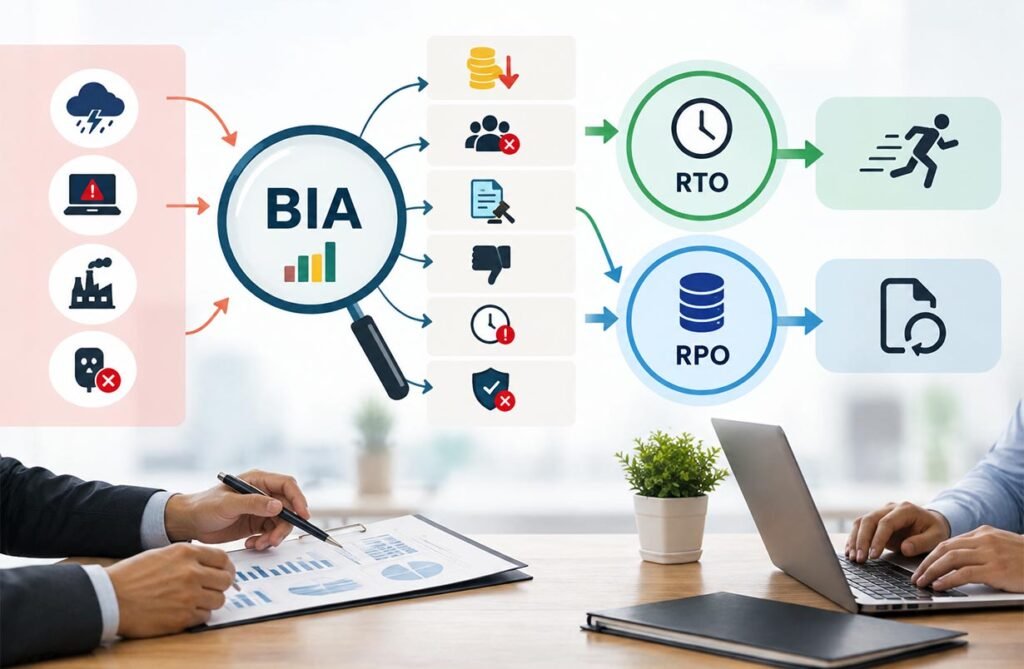
A Business Impact Analysis (BIA) studies how a disruption could affect important operations over time. It may look at lost sales, delayed services, safety problems, legal duties, customer complaints, extra costs, and damage to reputation. Ready.gov places the BIA at the centre of continuity planning and links it with recovery targets for business processes, technology, and data.
Two useful measures are the Recovery Time Objective (RTO) and Recovery Point Objective (RPO). RTO shows how quickly a process or system should return after disruption. RPO shows how much recent data a business can afford to lose. These targets help teams choose suitable backups, recovery tools, and temporary work methods.
Assess Risks and Reduce Weak Points
A risk assessment asks what could interrupt the organisation and how serious each event could be. Risks may include cybercrime, hardware failure, severe weather, fire, power cuts, staff shortages, transport problems, supplier failure, or loss of a workplace. Businesses should consider both the chance of an event and the damage it may cause.
Strong Business Continuity Strategies may include fire protection, cyber controls, backup power, staff cross-training, extra internet connections, secure cloud services, spare equipment, and more than one supplier. Prevention cannot stop every incident, but it can reduce disruption and make recovery faster.
Protect Data, Systems, and Backups
Modern businesses depend heavily on digital systems. Important data should have regular backups, and the business should know how those backups will be restored. Backup copies should be protected from the same event that affects the main system. Access controls, software updates, security monitoring, and tested recovery procedures can also lower technology risk.
NIST explains that contingency planning may include alternate equipment, manual work, or alternate locations when normal systems are unavailable. A business should document which applications must return first, who can restore them, and how employees will work until normal systems are available again.
Prepare Employees and Communication
Employees need clear instructions during an emergency. The plan should name people who can make decisions and assign backup staff if key leaders are unavailable. Contact details should stay current. Staff should understand evacuation, remote-work, reporting, and information-protection procedures.
Business Continuity Strategies should also explain how the company will contact employees, customers, suppliers, emergency services, and other key groups. Messages should be simple, accurate, and approved by responsible staff. A second communication method is useful if normal email, phones, or internet services fail.
Plan for Suppliers and Work Locations
A business may have a good internal plan and still face delays if a key supplier cannot deliver. Companies should identify suppliers that support critical services and prepare alternatives. Important contracts may include continuity expectations, delivery options, and recovery duties. Keeping approved backup suppliers can reduce long service gaps.
Workplace loss is another concern. A fire, flood, security event, or local outage may make a site unavailable. A company may need remote work, another branch, a temporary location, or manual processes. Ready.gov guidance also covers alternate worksites, resource needs, logistics, and IT restoration.
Test the Plan Before a Real Emergency
A plan that has never been tested may fail when it is needed most. Testing shows whether employees understand their roles and whether backup systems, contact lists, suppliers, and recovery procedures work. Tests can begin with simple discussion exercises and later include system recovery tests, communication drills, or realistic disruption scenarios.
The plan should be reviewed after every test and major incident. NIST recovery guidance supports planning, testing, learning from events, and improving recovery methods. Businesses should record problems found during exercises, give each improvement to a responsible owner, and set a date for completion.
Keep the Continuity Plan Current
Businesses change during the year. They add staff, software, suppliers, buildings, products, and customer services. A continuity plan can quickly become outdated if these changes are not added. Reviews should check contact information, critical systems, recovery priorities, backup procedures, suppliers, and emergency responsibilities.
Effective Business Continuity Strategies are part of normal management, not a document stored and forgotten. ISO 22301:2019 describes a system that organisations establish, operate, monitor, review, maintain, and continually improve. A newer edition is under development, while the 2019 edition remains the published international standard.
FAQs
What is the main purpose of business continuity planning?
Its main purpose is to keep critical activities running during disruption and restore normal operations in a controlled way. It also helps protect employees, customers, information, income, and important services.
What is the difference between business continuity and disaster recovery?
Business continuity covers the whole organisation, including people, processes, suppliers, facilities, communication, and technology. Disaster recovery mainly focuses on restoring IT systems and data after an outage or disaster.
How often should a continuity plan be tested?
There is no single schedule for every business. Tests should happen regularly and after major changes. Critical systems or higher-risk activities may need more frequent testing.
Does a small business need a continuity plan?
Yes. A small company may have fewer backup resources, so a long disruption can be serious. Even a simple plan can identify critical work, emergency contacts, data backups, alternative suppliers, and temporary work methods.
What should a continuity plan include?
A useful plan should cover critical activities, risks, recovery priorities, roles, contact details, backup systems, data recovery, suppliers, alternative work methods, communication, testing, and regular updates.