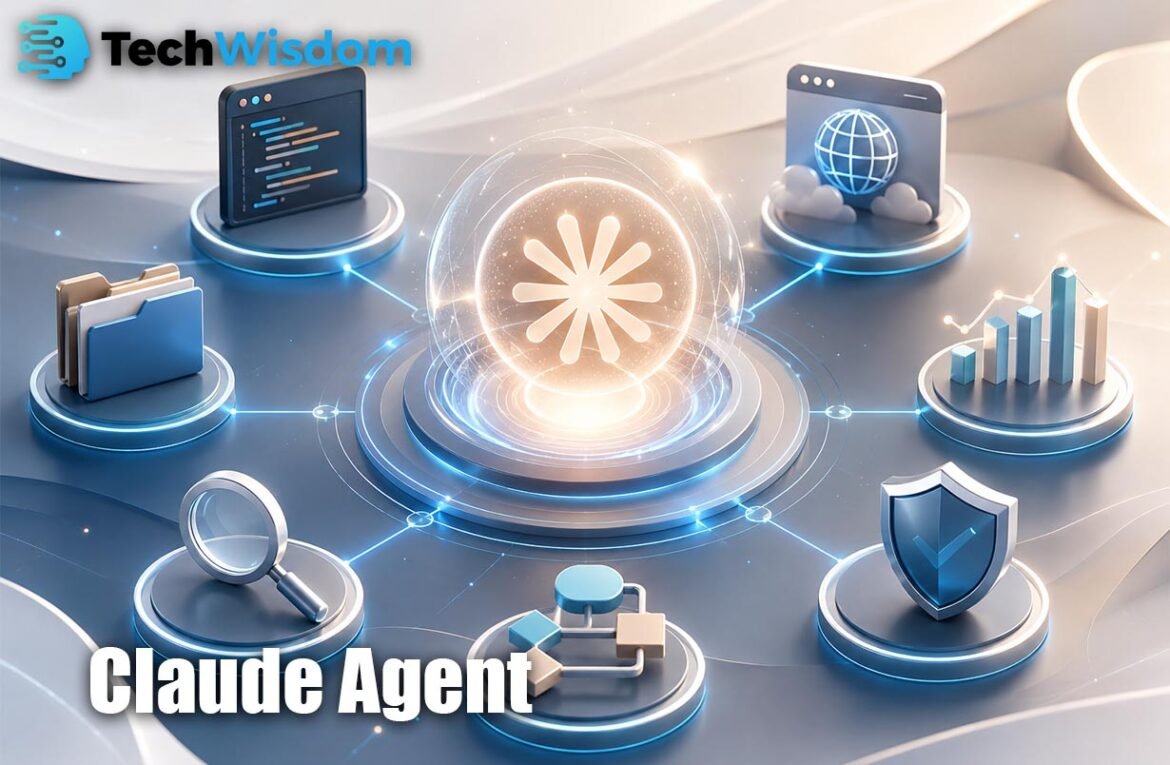
A Claude Agent is an AI system powered by Anthropic’s Claude models that can do more than answer a question. It can understand a goal, choose tools, perform actions, study the results, and decide what to do next. This makes agent-based systems useful for tasks that need several steps, such as coding, research, support, data work, and business automation.
What Is Claude Agent and How Does It Work?
A Claude Agent works through an agentic loop. The user gives a goal, the model studies the request, chooses an action, uses a tool when needed, receives the result, and then decides whether more work is required. This process can repeat several times until the task is finished or human approval is needed.
Anthropic explains that an agent is different from a fixed workflow. A workflow follows steps decided in advance, while an agent can choose its own path as new information appears. This is useful when a task is open-ended and the correct next step cannot always be known before the work starts.
Claude Code, the Agent SDK and Managed Agents
Claude Code is Anthropic’s agentic coding product. It can explore a codebase, edit files, run commands, test changes, and help developers solve larger programming tasks. The Agent SDK gives developers building blocks for creating their own agents for coding, research, security, support, and other fields.
Anthropic also offers Managed Agents, where more of the agent infrastructure runs on Anthropic’s systems. A managed agent can combine a Claude model, system prompt, tools, MCP servers, and skills in one reusable configuration. This gives developers different choices depending on how much infrastructure they want to manage.
Key Features That Make Agents Useful
One major feature is multi-step reasoning. The model can break a large goal into smaller actions and change direction when a result is not useful. It does not need every step to be written in advance. This makes it suitable for troubleshooting, investigation, document analysis, and other jobs where the path may change.
Agents can also keep useful context during a session and work with tools, files, APIs, or external services. Developers can control the system with prompts, tool definitions, permissions, and rules. Good agent design gives the model enough freedom to solve the task while keeping important actions limited and visible.
Built-In Tools and External Connections
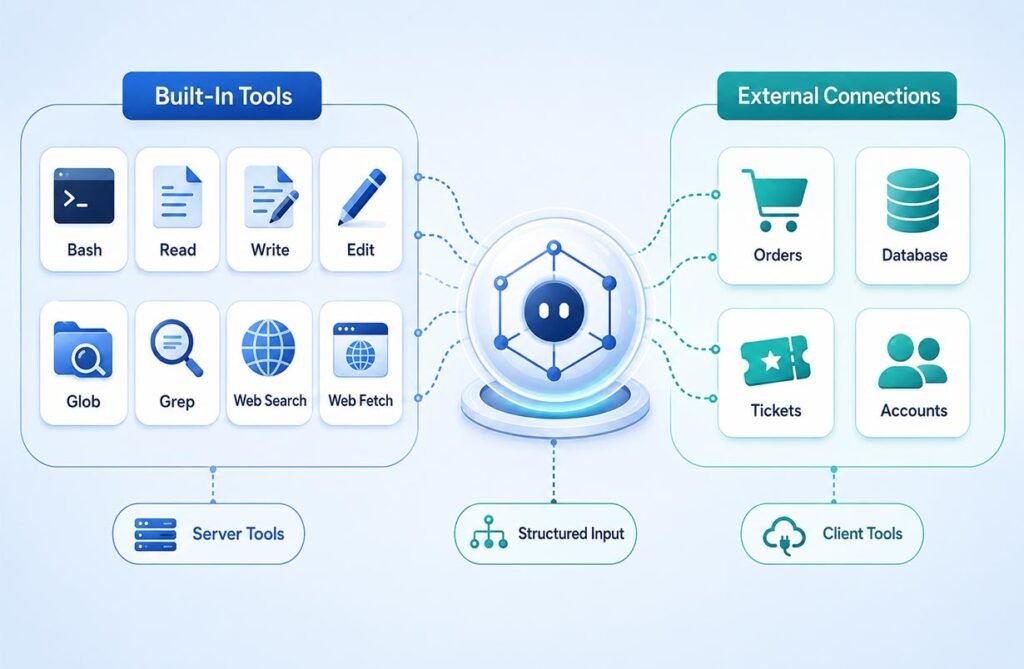
Tools turn a language model into a system that can act. Anthropic’s managed toolset includes Bash, Read, Write, Edit, Glob, Grep, web search, and web fetch. These tools can let an agent inspect files, change content, search text, execute shell commands, or collect information from the web.
Claude can also use developer-defined tools. A business tools could create functions for checking an order, reading a database, creating a ticket, or getting account details. Claude chooses a tool from its description and provides structured input. Client tools run in the developer’s application, while some server tools run on Anthropic infrastructure.
How MCP, Skills and Custom Tools Extend Claude
The Model Context Protocol (MCP) is a standard way to connect AI applications with outside data and tools. Through an MCP server, an agent may work with company systems, developer services, databases, or other supported resources without requiring every connection to use a completely different structure.
Agent Skills provide another way to give Claude reusable instructions, examples, and task knowledge. Custom tools provide actions, while skills can guide how work should be done. Together, tools, MCP connections, prompts, and skills can create agents designed for a specific job instead of a general chat experience.
Practical Uses for Coding, Research and Business
A Claude Agent can be useful in software development because code gives clear feedback. An agent can search project files, make a change, run tests, read errors, and try another solution. It can also help with code migration, debugging, security review, documentation, and understanding large codebases.
Outside coding, agents can support research, customer service, incident investigation, compliance work, and internal operations. A research agent can search several sources and compare findings. A support agent can combine knowledge-base information with approved account tools. Business teams can use agents where a task has many changing steps.
Permissions, Human Approval and Safety Controls
More tool access creates more risk. An agent may misunderstand a request, choose the wrong action, or follow harmful instructions hidden inside outside content. Prompt injection is an important example. A malicious webpage or document may contain instructions designed to influence an agent that reads it.
Developers can reduce risk with limited permissions, sandboxing, logging, testing, and human approval. Anthropic’s managed tool configuration supports permission policies, so some tool calls can be approved automatically while others require confirmation. High-impact actions should receive stronger controls than simple reading or search actions.
Benefits and Limitations to Understand
The main benefit of a Claude Agent is flexibility. It can react to new information instead of following one fixed script. It can combine reasoning with real tools, work across several steps, and handle tasks that would be difficult to automate with simple rules. This can save time on complex digital work.
The limits are equally important. Agents can still make mistakes, use unnecessary steps, or misunderstand information. Tool calls and repeated model turns can increase cost and processing time. Complex designs can add even more overhead. Anthropic recommends simple, composable approaches instead of adding complexity without a clear benefit.
When an Agent Is the Right Choice
An agent is most useful when the task has a clear goal but an uncertain path. Good examples include investigating a software failure, researching a difficult question, reviewing many related documents, or solving a support problem that may require several systems. In these cases, the next action depends on what the agent discovers.
A normal model request or fixed workflow can be better for simple and predictable tasks. The goal should not be to make every process autonomous. Claude Agent technology is strongest when flexible reasoning, controlled tool use, and repeated feedback produce a better result than a simple one-step response or a hard-coded process.
FAQs
Is It the Same as Claude Code?
No. Claude Code is a coding-focused product, while the broader agent approach can be used for many types of tasks.
What Tools Can Claude Use?
Depending on the setup, Claude can use tools for files, shell commands, web search, web fetch, custom APIs, and connected services.
What Is MCP in Claude?
MCP means Model Context Protocol. It helps AI applications connect with external tools and data through a common standard.
Can Claude Agents Work Without Human Approval?
They can automate selected actions, but developers can require approval for sensitive or high-impact tool calls.
Are Claude Agents Only for Developers?
No. Developers build the systems, but final agents can support users in research, customer service, operations, security, coding, and other business tasks.