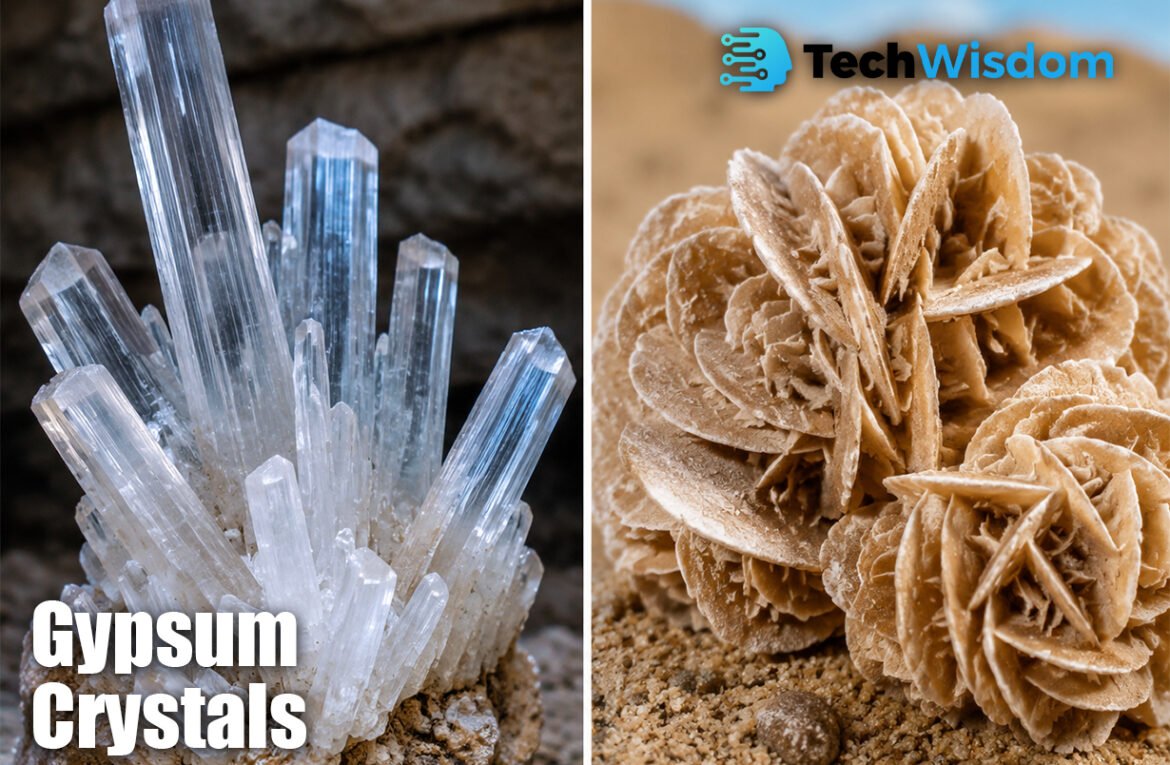
Gypsum crystals are natural mineral formations known for their delicate shapes, soft texture, and beautiful appearance. They are made from calcium sulfate dihydrate and form when mineral-rich water slowly loses moisture. Found in caves, deserts, and ancient sea deposits, these minerals reveal important details about Earth’s history. From giant underground formations to decorative stones, they have both scientific value and practical uses.
What Are Gypsum Crystals and Why Are They Unique?
Gypsum is a common sulfate mineral with the chemical formula CaSO₄·2H₂O. These Gypsum Crystals contain water inside their structure, which makes them different from many other minerals. Their softness, transparency, and ability to form large shapes make them popular among collectors .
One special feature of gypsum is its wide range of appearances. Some crystals are clear like glass, while others are white, gray, yellow, or brown because of natural impurities. The mineral can develop into several forms, including selenite, satin spar, desert rose, and alabaster.
Unlike harder minerals such as quartz, gypsum can be scratched easily. It has a hardness rating of 2 on the Mohs scale, meaning it is soft enough to mark with a fingernail. This softness allows artists and builders to shape gypsum into useful materials.
How Do Gypsum Crystals Form Naturally?
The formation of Gypsum Crystals begins when calcium and sulfate minerals dissolve in water. When this mineral-rich water becomes highly concentrated because of evaporation or environmental changes, gypsum starts to separate from the solution and slowly grows into crystals.
This process often happens in places where water collects and disappears over long periods. Ancient seas, salt lakes, and underground water systems provide ideal conditions for crystal growth. The slower the growth process, the larger and clearer the final crystal can become.
Temperature, pressure, water chemistry, and available space all affect crystal development. In some locations, crystals grow inside underground cavities where they have enough room to expand into impressive shapes.
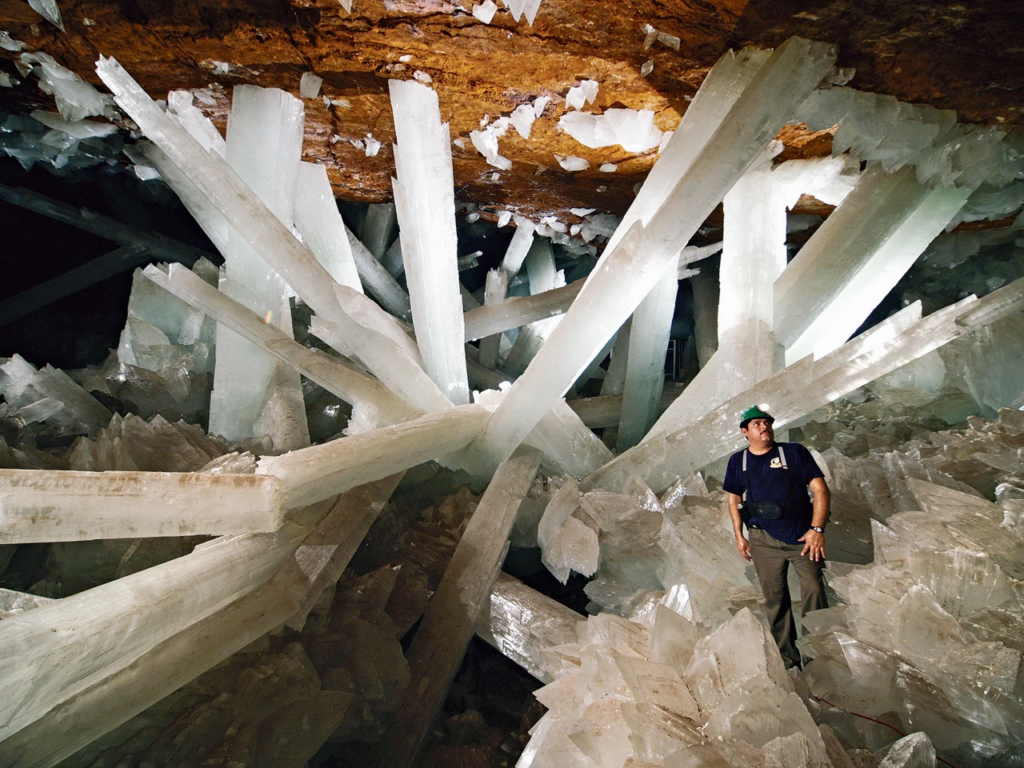
A famous example is the Cave of the Crystals in Naica, Mexico, where enormous selenite crystals developed under rare geological conditions. These crystals grew over hundreds of thousands of years in extremely warm, mineral-rich water.
Where Are Gypsum Crystals Found Around the World?
Gypsum deposits exist in many regions because the mineral forms in environments connected with evaporation and groundwater activity. Large deposits are found in countries such as Mexico, the United States, Canada, Spain, Morocco, Australia, and China.
One remarkable location is White Sands National Park in New Mexico, USA, which contains one of the largest gypsum sand fields on Earth. The area formed from ancient lake deposits that broke down into fine white sand.
Cave systems are another important place to discover gypsum formations. Underground water carries dissolved minerals through rocks, and changing conditions allow crystals to grow on cave walls and surfaces.
Desert areas also produce unique formations called desert roses. These flower-like structures form when gypsum crystals grow around trapped sand particles, creating a natural pattern that looks like layered petals.
What Are the Different Types and Forms of Gypsum Crystals?
Gypsum appears in several varieties, each with its own structure and visual qualities. The most recognized type is selenite, which is a clear or transparent form of gypsum. Selenite crystals often grow as flat, blade-shaped pieces with a glass-like shine.
Satin spar is another variety with a silky appearance. It contains tiny fibrous crystals that reflect light and create a smooth, glowing effect. This type is often used for decorative objects.
Desert rose gypsum has a unique flower-shaped structure. It forms in dry environments where sand becomes trapped between growing crystal layers. These formations are especially popular with mineral collectors.
Alabaster gypsum is a fine-grained variety known for its smooth texture. It has been used for centuries to create sculptures, carvings, and artistic decorations because it is easy to shape.
What Physical Features and Properties Define Gypsum Crystals?
The beauty of Gypsum Crystals comes from their combination of physical and chemical properties. They belong to the monoclinic crystal system, which influences their growth patterns and shapes.
Important features include:
- Chemical formula: CaSO₄·2H₂O
- Mineral group: Sulfate minerals
- Hardness: 2 Mohs
- Luster: Glassy, pearly, or silky
- Color: White, clear, gray, yellow, brown, and other shades
- Transparency: Transparent to opaque
The presence of water molecules inside gypsum gives it special behavior when heated. When exposed to high temperatures, gypsum loses some water and changes into plaster of Paris, a material widely used in construction and medicine.
How Do Environmental Conditions Affect Crystal Growth?
Crystal growth depends heavily on the environment where the mineral develops. A stable supply of mineral-rich water allows gypsum to grow slowly and evenly. Sudden changes may stop growth or create smaller, less developed crystals.
High evaporation rates are common in desert and salt lake environments. These conditions increase mineral concentration and encourage crystal formation. Underground environments often produce larger crystals because they provide protection from weather changes.
The Naica Mine crystals are a perfect example of how unusual conditions can create extraordinary results. The combination of hot water, mineral saturation, and stable temperatures allowed some of the largest natural crystals ever discovered to develop.
What Are the Common Uses of Gypsum Crystals and Gypsum Minerals?
Beyond appearance, Gypsum Crystals have many practical applications because gypsum is a useful industrial mineral. The construction industry uses gypsum to produce drywall, plasterboard, cement additives, and decorative materials.
When gypsum is processed into plaster, it becomes valuable for medical casts, molds, and artistic designs. Its ability to harden after mixing with water makes it useful for many different purposes.
Agriculture also benefits from gypsum because it can improve soil structure and provide calcium and sulfur nutrients. Farmers use gypsum to support healthier soil conditions, especially in areas affected by salt problems.
Collectors and museums value attractive crystal specimens because they display natural mineral beauty. Clear selenite pieces and unusual desert roses are often preserved as educational and decorative items.
Why Are Gypsum Crystals Important in Science and Industry?
Today, Gypsum Crystals continue to interest scientists because they provide clues about ancient environments and geological changes. Their formation helps understand past oceans, climate conditions, and underground water movement.
Geologists study gypsum deposits to learn how minerals formed millions of years ago. These studies can reveal information about Earth’s changing landscapes and natural processes.
The mineral also remains important in modern industries. Its availability, useful chemical properties, and simple processing methods make gypsum a valuable resource worldwide.
Understanding this mineral helps people appreciate how natural processes create materials that support science, construction, art, and everyday life.
FAQs
What are gypsum crystals made of?
They are made of calcium sulfate dihydrate with the chemical formula CaSO₄·2H₂O.
Are gypsum crystals valuable?
Some specimens, especially large or clear selenite crystals, can be valuable to collectors.
Where are the largest gypsum crystals found?
The largest known examples are found in the Cave of the Crystals in Naica, Mexico.
Can gypsum crystals be used in construction?
Yes. Gypsum is widely used for drywall, plaster, cement products, and building materials.
How can you identify gypsum?
Gypsum can be identified by its softness, crystal shape, and ability to be scratched easily.