
Snorkel AI is an artificial intelligence company that focuses on the data used to train, test, and improve AI systems. The company grew from research at the Stanford AI Lab and became well known for weak supervision and programmatic labeling. Today, its work also includes expert training data, model evaluation, benchmarks, fine-tuning, and realistic testing environments for AI agents. Its main goal is to help organizations build AI systems that can handle difficult and specialized real-world tasks.
What Is Snorkel AI and How Does It Work?
The company uses a data-centric AI approach. This means developers focus on improving the information used by a model instead of only changing the model itself. Better examples, clearer labels, difficult test cases, and expert knowledge can often make an AI system more useful.
The company now describes itself as a frontier AI data lab. It builds datasets, evaluations, benchmarks, expert demonstrations, reasoning examples, preference labels, and testing environments for advanced AI models and agents. This is broader than traditional data annotation because it supports many stages of AI development.
How Snorkel AI Creates Better Training Data
Training data is the information a machine learning model studies while learning a task. If this information is incomplete, inaccurate, or poorly labeled, the final model may also perform badly. Snorkel AI helps teams improve this data by combining expert knowledge with automated data-development methods.
Subject-matter experts can create rules, review difficult cases, write strong examples, explain reasoning, or compare different model answers. Their knowledge can then be used across a larger dataset. This reduces repetitive manual work while keeping human expertise inside the development process.
Weak Supervision and Programmatic Labeling Explained
One of the company’s best-known ideas is weak supervision. This approach uses different labeling signals that may not be completely accurate on their own. Several signals can be combined to create stronger training labels.
Programmatic labeling uses small rules known as labeling functions, or LFs. A labeling function can use keywords, regular expressions, databases, existing models, embeddings, business rules, or even outputs from another language model. These rules can label many examples much faster than manual annotation alone.
The platform can also study conflicts between labeling functions. It can combine their signals and produce probabilistic labels for training. Developers can then train a model, study its errors, update the functions, and repeat the process until performance improves.
Snorkel AI Models and Data Development
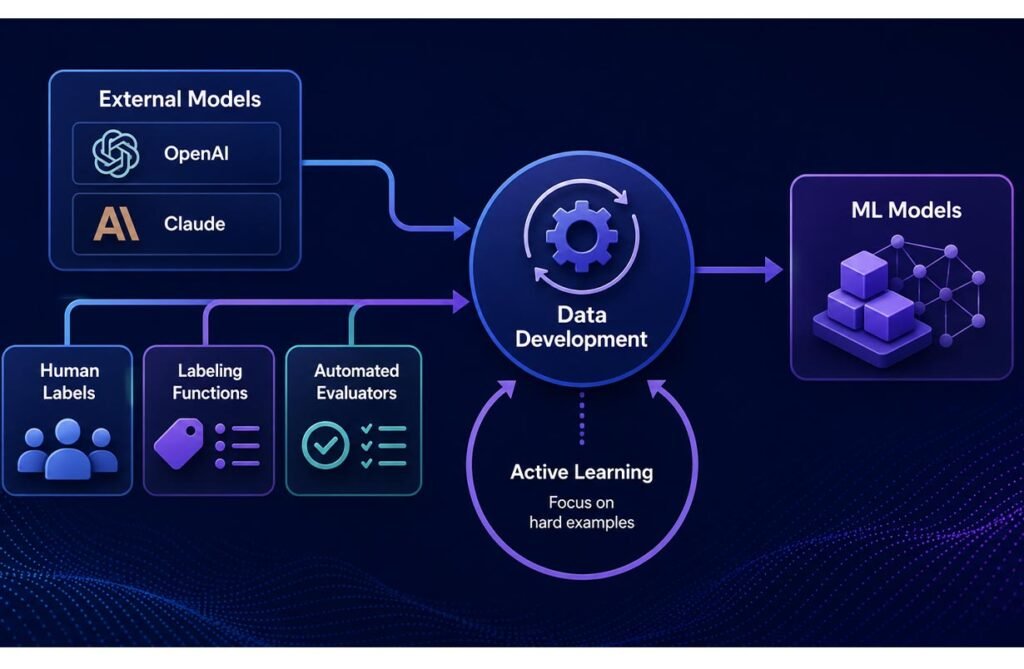
Snorkel AI is different from companies that mainly build large foundation models. Its main value comes from helping teams create better data and evaluate the models they already use. Current documentation shows support for connecting outside foundation models, including models from OpenAI and Anthropic’s Claude.
Its workflow can combine human labels, labeling functions, automated evaluators, and machine learning models. It also uses active learning, where a model identifies examples that are difficult or uncertain. Experts can then focus their time on these important cases rather than reviewing every item in a dataset.
Main Features of the Platform
A major feature is programmatic labeling, which allows expert knowledge to become reusable labeling rules. Weak supervision combines different signals, while active learning helps identify valuable examples that need human attention. Error analysis can show where a model is weak instead of giving teams only one general accuracy number.
Other important capabilities include expert datasets, reasoning traces, preference rankings, workflow demonstrations, custom rubrics, automated evaluators, benchmarks, and agent environments. Evaluation tools can use rules, classifiers, embedding similarity, human feedback, and programmatic supervision to measure model quality.
LLM Training, Fine-Tuning and Evaluation
Large language models may understand general topics well but still struggle with specialized business tasks. A legal assistant, for example, may need knowledge of contracts and company rules. A financial assistant may need to understand specific documents, policies, calculations, and decision processes.
Snorkel AI supports the creation of focused datasets that can be used for LLM fine-tuning and alignment. Fine-tuning means training an existing model on a smaller, specialized dataset so that it performs better on a certain type of task.
Evaluation is another important part of the process. Teams can define success criteria, create reference prompts, organize test data into different slices, and compare automated evaluators with judgments from human experts. This helps determine whether a model is actually ready for production use.
AI Agents, Benchmarks and Real-World Testing
Modern AI agents can do more than answer questions. They may open software tools, search documents, use databases, write files, update records, and complete several steps before finishing a task.
This makes agent evaluation difficult. A correct final answer does not always mean that the agent followed the correct process.
The company’s newer research focuses on realistic environments that can contain browser tools, command-line systems, code repositories, documents, databases, and multi-step workflows. In August 2026, Snorkel described environments for fields including insurance, finance, manufacturing, legal work, sales, and marketing. These environments can support both model evaluation and reinforcement learning.
Enterprise Use Cases and Integrations
Snorkel AI is mainly useful for organizations where accuracy and specialist knowledge are important. Possible applications include document classification, data extraction, customer support, financial analysis, insurance underwriting, legal work, enterprise assistants, and software development agents.
The technology can also work with outside model providers instead of forcing companies to use only one AI model. This gives enterprise teams more freedom when testing different systems or changing providers.
Earlier Snorkel work has also shown how specialized smaller models can perform strongly when they receive better task-specific data. This supports the idea that organizations do not always need the largest possible model for every business problem.
Pricing, Security and Who Should Use It
The company does not present its main services like a simple consumer AI product with a fixed monthly price. Its current offering often involves custom datasets, expert data work, evaluation systems, benchmarks, and environments, so businesses usually need to discuss their needs directly with the company.
Security is important because enterprise datasets may contain private information. Snorkel’s documentation includes enterprise-focused controls and methods for protecting data during AI development.
The service is best suited to AI labs, machine learning teams, data scientists, and large organizations working on complex or specialized AI systems. A small company that only needs a simple chatbot may not require this level of data development.
Benefits and Limitations
The main strength of Snorkel AI is its focus on improving AI through better data. Programmatic methods can reduce repetitive labeling, while human experts can focus on difficult decisions. Custom evaluations can also show detailed failure areas that may be hidden by a simple benchmark score.
However, the approach still requires planning and domain knowledge. Weak labeling rules can add noise, and automated evaluators must be checked against human judgments. Creating specialized benchmarks or realistic agent environments can also require significant work. For complex enterprise AI projects, these efforts can provide much stronger control over model quality and reliability.
FAQs
What is the platform mainly used for?
It is used to create training datasets, evaluations, benchmarks, labeling systems, and testing environments for machine learning models and AI agents.
What is weak supervision?
Weak supervision uses several imperfect rules or information sources together to create useful training labels at a larger scale.
What is a labeling function?
A labeling function is a reusable rule that labels data using information such as keywords, business logic, databases, models, or patterns.
Can it work with external AI models?
Yes. Its current documentation supports connections with third-party foundation models, including OpenAI models and Claude.
Is it only a data-labeling platform?
No. Its current work goes beyond labeling and includes expert data, model evaluation, fine-tuning support, benchmarks, reasoning data, and realistic AI-agent environments.