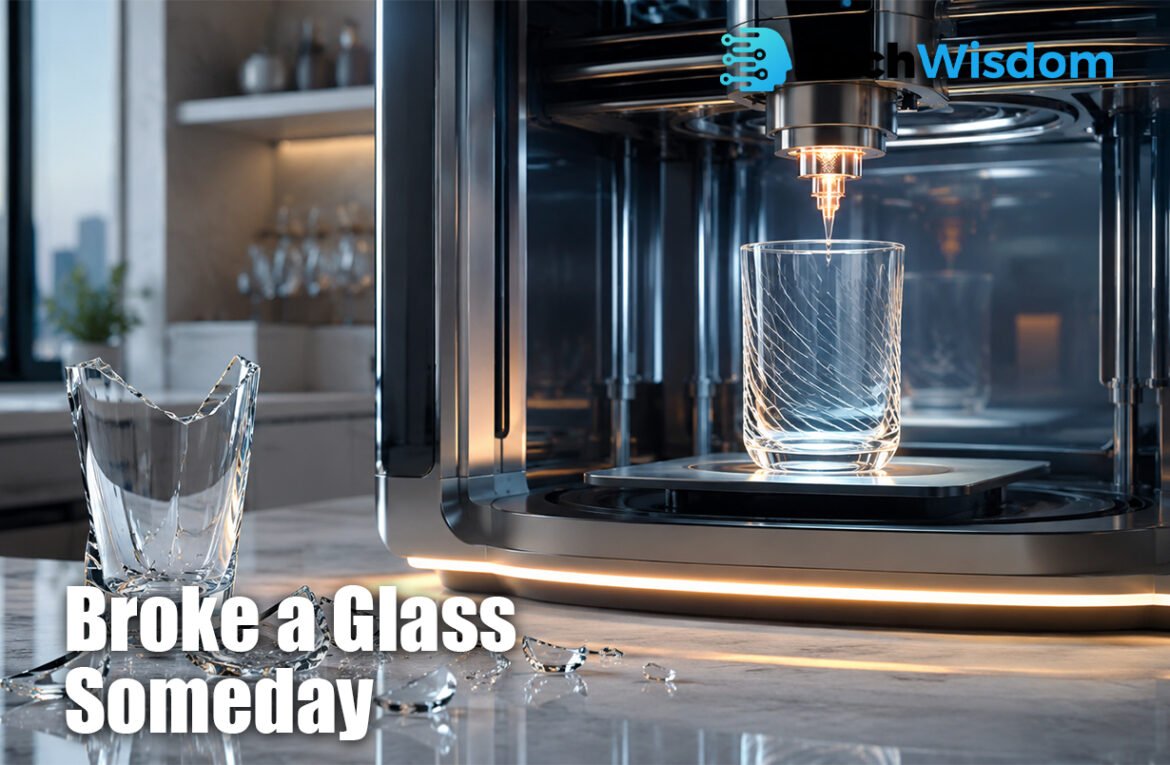
Have you ever dropped a glass and wished you could make the same one again? Broke a Glass Someday describes an exciting future where a special 3D printer may create a replacement glass object from a digital design. This technology already exists in centres, but it is still developing. Scientists are learning how to print clear, strong, and detailed glass for homes, hospitals, laboratories, buildings, and communication systems.
What Does “Broke a Glass Someday” Mean?
The phrase Broke a Glass Someday comes from the idea that people may one day print a new glass after breaking an old one. A person could scan the broken object, find its digital file, and send the design to a special printer. The printer would then build a similar object by following the shape stored in the computer.
This does not mean that every home can print drinking glasses today. Most glass printers are large, expensive, and difficult to operate. However, have already printed containers, columns, lenses, bricks, and tiny scientific parts. The phrase therefore describes a possible future based on real technology rather than a simple dream.
How 3D Glass Printing Technology Works
A normal 3D printer builds an object by adding material in layers. Most home printers use plastic, but a glass printer uses molten glass, glass powder, or a special liquid containing glass materials. A computer controls where the material goes and how the final object takes shape.
One method heats glass to around 1,000°C until it becomes soft enough to flow through a special nozzle. Other methods use light to harden a liquid mixture. The printed object is later heated inside a furnace. This removes unwanted materials and joins the glass particles together.
Main Methods Used to Print Glass Objects
The MIT Media Lab introduced an important system called G3DP, meaning Glass 3D Printing, in 2015. The machine kept glass hot inside a chamber and pushed it through a heat-resistant nozzle. It placed the hot material in controlled layers to produce transparent and curved objects.
Other methods use glass powder mixed with a plastic binder. The mixture is easy to shape at first. After printing, the object enters a furnace. The binder burns away, and the remaining particles join together. Light-based and laser-based methods can also produce very small parts for cameras, sensors, and medical devices.
Can You Print a Replacement Drinking Glass?
The main promise behind Broke a Glass Someday is the ability to replace a damaged object. In theory, a printer could use a digital model to create a matching cup, vase, lamp cover, or decorative item. This may be especially useful for rare products that are no longer available in shops.
However, printing an ordinary drinking glass is not practical for most people yet. A factory can produce thousands of simple glasses quickly and cheaply. A specialist printer is more useful when an object has a complex shape, unusual size, internal channels, personal details, or a design that would be difficult to make with a traditional mould.
Benefits Compared With Traditional Glassmaking
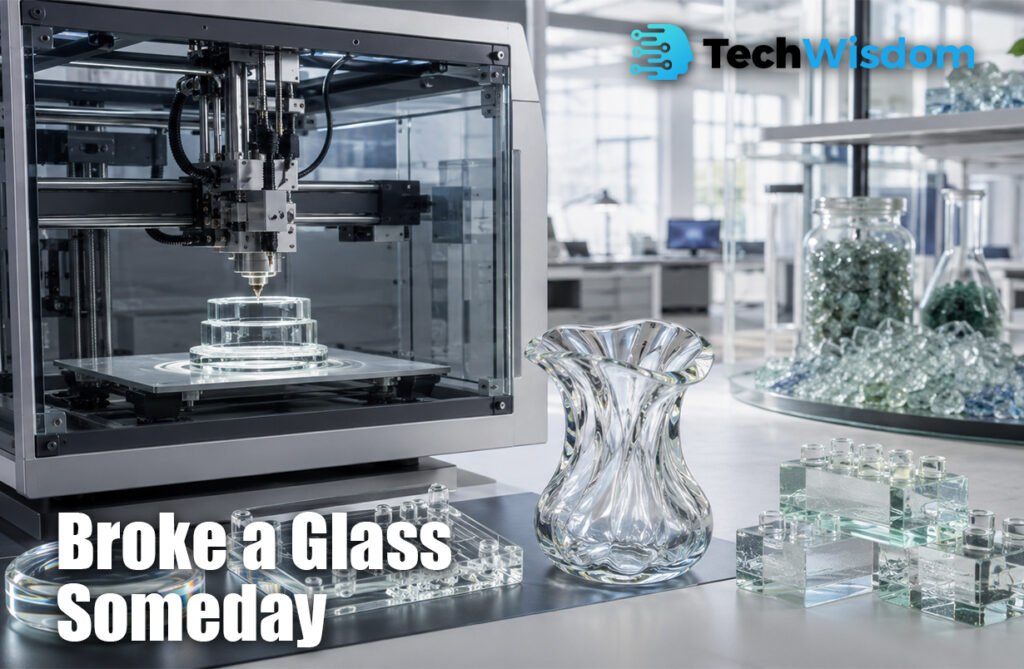
Traditional glassmaking includes blowing, casting, cutting, and moulding. These methods remain effective, but they may require expensive tools or moulds. A 3D printer works directly from a digital file, so designers can change the shape without creating a completely new production system.
Glass printing also gives designers more freedom. They can create curved walls, small holes, detailed patterns, and hidden channels inside an object. Several separate parts may become one printed structure. This can reduce assembly work and help engineers make lighter or more useful products.
Uses in Medicine, Optics, and Construction
In medicine, printed glass may support small diagnostic tools, fluid channels, endoscope parts, and laboratory devices. Glass is useful because it can be transparent, chemically stable, and easy to clean. can also create a different design for a particular experiment or medical need.
In optics, printed glass may form lenses, sensors, laser parts, and fibre-optic components. In construction, MIT engineers have tested interlocking bricks made from recycled printed glass. These bricks were designed to be taken apart and reused, supporting a more circular way of building.
How Recycled Glass Supports This Technology
The future described by Broke a Glass Someday may also reduce waste. Broken bottles, windows, and containers can sometimes be cleaned, crushed, melted, and prepared as material for new products. Instead of sending all damaged glass to a landfill, manufacturers may turn part of it into useful printed objects.
Recycled glass printing may support furniture, art, building blocks, and custom products. It can also reduce the need for new raw materials. Still, recycling requires careful sorting because different types of glass melt at different temperatures and may contain colours, coatings, metals, or other unwanted materials.
Safety, Cost, and Quality Challenges
Glass is difficult to print because it requires very high heat. The printer must protect workers from hot material and control the temperature closely. If one part cools faster than another, internal stress can form. This may cause the object to crack during printing or break later.
Surface quality is another problem. Printed layers may leave visible lines, which can reduce clarity. Machines, furnaces, lasers, and control systems are also expensive. Must improve speed, strength, energy use, and accuracy before the technology can become common in local workshops or homes.
Is 3D-Printed Glass Safe to Use?
Not every printed glass object is safe for food or drinks. A cup must use food-safe materials and have a smooth surface that is easy to clean. It must also be tested for strength, heat resistance, chemicals, cracks, and sharp areas before people use it.
Medical and building products require even stricter checks. A printed lens must control light correctly, while a building brick must carry weight safely. For this reason, manufacturers need clear testing standards for each product. Attractive design alone does not prove that an object is safe.
The Future of Custom Glass Replacement
The vision behind Broke a Glass Someday may become more realistic as printers improve. Future machines could become faster, safer, and more affordable. Better software may control heat, cooling, material flow, and shrinkage automatically. Artificial intelligence may also help designers choose the strongest shape before printing starts.
Local printing centres may become more common before home glass printers do. A customer could upload a file, choose the size and material, and order one replacement. Companies may also store digital designs for older products, allowing customers to replace one broken part instead of buying a complete new set.
Broke a Glass Someday is therefore about more than a broken cup. It shows how glass is becoming a digital material. The technology already supports art, medicine, optics, and construction. Although major challenges remain, printed glass may one day make custom replacement, recycling, and local production easier.
FAQs
Is 3D-printed glass real?
Yes. We have printed transparent containers, architectural columns, lenses, scientific parts, and recycled-glass bricks.
Can a home 3D printer print glass?
No. Most home printers cannot reach the required temperature or provide the special cooling and safety systems needed for glass.
Is printed glass strong?
It can be strong, but its strength depends on the material, shape, printing method, cooling process, and number of internal defects.
Can broken glass become printing material?
Some broken glass can be cleaned, sorted, crushed, and melted for reuse. It must first be free from unsuitable materials and coatings.
Will glass printing replace factories?
It will probably support custom and complex production rather than replace factories that already make simple cups, bottles, and windows efficiently.