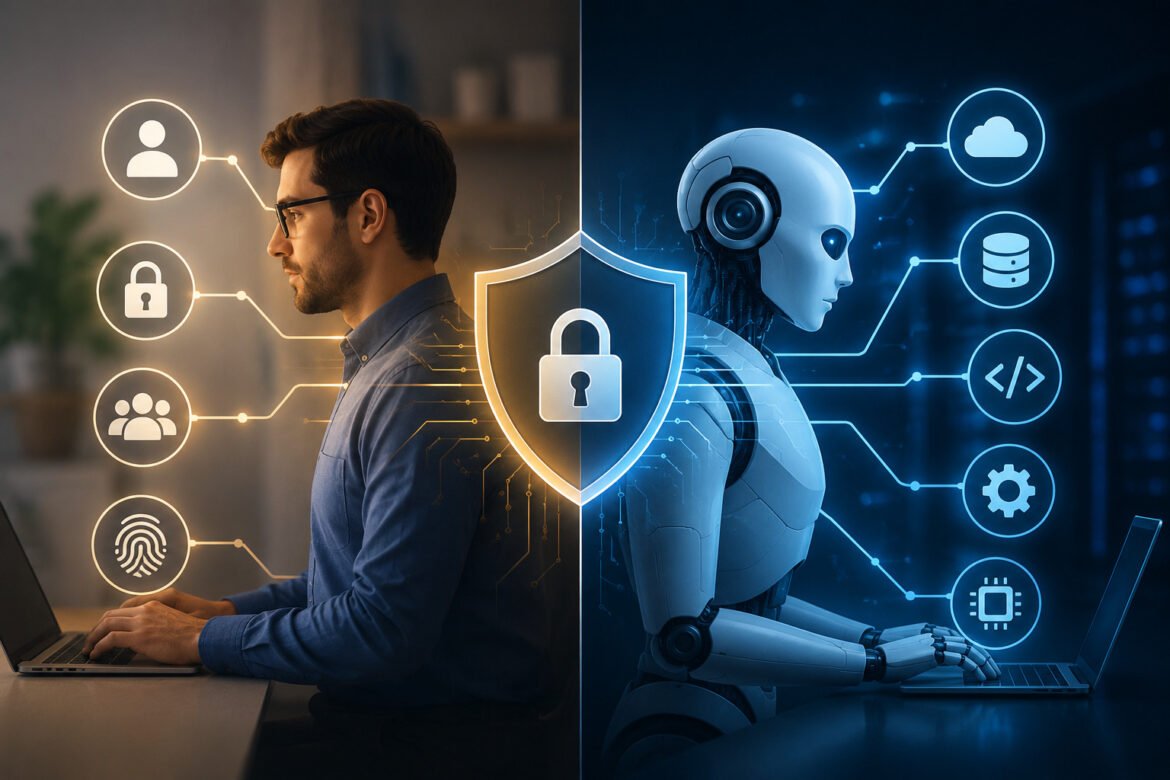
Modern businesses rely on both people and technology to complete daily work. Employees log into company systems to perform their jobs, while applications, cloud services, APIs, and automated tools also need secure access. These systems cannot type a password or verify their identity like a person. Instead, they use digital credentials that allow them to communicate safely. Understanding the difference between human identities and Non Human Identity helps organizations improve security, reduce unnecessary access, and protect valuable data.
What Is a Human Identity, and What Is a Non Human Identity?
A human identity is a digital identity that belongs to a real person. It allows employees, customers, contractors, or partners to sign in to applications, databases, and online services. A human identity normally includes a username, password, email address, job role, and access permissions. Many organizations also require Multi-Factor Authentication (MFA) to add another layer of protection.
A Non Human Identity belongs to a machine instead of a person. It may represent an application, cloud workload, API, container, virtual machine, script, bot, or AI agent. These identities use digital credentials such as API keys, OAuth tokens, SSH keys, or TLS certificates to prove who they are. This allows software to communicate securely without human involvement.
The purpose of both identity types is the same: they verify who or what is requesting access. However, the way they authenticate and the way they are managed are very different. As organizations adopt more cloud services and automation, machine identities continue to grow much faster than employee accounts.
Why Non Human Identities Have Become Essential in Modern IT Environments
Businesses no longer depend on a single application running on one server. Today, they use cloud platforms, microservices, containers, serverless computing, and automated workflows. Every service needs a secure way to identify itself before exchanging information with another service.
This is where Non Human Identity plays a critical role. Without it, applications would not know whether they can trust another application requesting data or services. Every automated process requires authentication before it can continue.
For example, an online banking application may connect to a customer database, a payment gateway, an email service, and a fraud detection system. Each connection requires its own identity and credentials. The customer never sees these connections, but they happen every second in the background.
Modern development methods such as DevOps and CI/CD pipelines create new applications and services regularly. Each new workload often requires its own identity. As a result, many companies now manage thousands of machine identities while employing only a few hundred people.
Non Human Identity vs Human Identity: The Key Differences at a Glance
Although both identity types provide secure access, they serve different purposes. A human identity always represents a person. It is used when an employee signs into an email account, accesses business software, or connects to company resources.
Another major difference is how these identities behave. Human users work during office hours, take breaks, and change passwords from time to time. Machine identities may operate twenty-four hours a day without interruption. They can process thousands of requests every minute while supporting applications used by millions of customers.
The lifecycle is also different. Human identities are created when someone joins an organization, updated when their role changes, and removed when they leave. Machine identities are created when applications are deployed and should be removed when those applications are retired. If old machine identities remain active, they can create unnecessary security risks.
Common Examples of Human and Non Human Identities in Everyday Business
Human identities are easy to recognize because they belong to people. Examples include office employees, customer support agents, accountants, database administrators, teachers, students, healthcare workers, contractors, and business partners. Each person receives permissions based on their responsibilities.
Examples of Non Human Identity are found throughout modern technology. A service account allows an application to connect to a database. An API key enables one application to request information from another. A Kubernetes service account allows containers to communicate securely inside a cluster. Cloud IAM roles give workloads permission to access storage, networking services, or databases.
Even simple automation depends on machine identities. When an online store automatically sends an order confirmation email or updates inventory after a purchase, these actions are completed through trusted software identities rather than a person manually performing each task.
How Authentication and Access Management Differ Between Human and Non-Human Identities
Authentication confirms that an identity is genuine before access is granted. Human users typically sign in using passwords, fingerprint recognition, facial recognition, security keys, or Multi-Factor Authentication. Many organizations also use Single Sign-On (SSO) so employees can access multiple applications with one secure login.
A Non Human Identity authenticates differently. Applications use credentials such as OAuth tokens, JWT tokens, SSH keys, digital certificates, cloud-managed identities, and API secrets. These credentials allow applications to communicate automatically without exposing sensitive passwords.
Access management is equally important. Employees receive permissions according to their job roles, while applications receive permissions based on the services they must access. Both should follow the principle of least privilege, which means granting only the minimum access required to complete a task.
Read More: techwisdom.co.uk
In Short
As businesses continue moving toward cloud computing, automation, AI, and DevOps, machine identities will continue to grow faster than human accounts. Understanding the differences between human and machine identities is no longer optional. It is an important part of modern cybersecurity.
A well-managed Non Human Identity program improves visibility, protects sensitive systems, limits unnecessary access, and reduces the risk of data breaches. By following security best practices and regularly reviewing permissions, organizations can protect both their employees and their automated systems while supporting future digital growth.
FAQs
What is a Non Human Identity?
A Non-Human Identity is a digital identity used by software, machines, applications, cloud workloads, APIs, or automated services to authenticate and access systems securely without direct human interaction.
Why is Non Human Identity important?
It enables secure communication between applications, cloud services, APIs, and automated tools while reducing unauthorized access and improving overall cybersecurity.
What is the biggest difference between human and machine identities?
Human identities belong to real people and usually use passwords and MFA. Machine identities belong to software or devices and use tokens, certificates, API keys, or cloud roles for automatic authentication.
Can a company have more machine identities than human identities?
Yes. Many modern organizations have thousands of machine identities because every application, API, container, and cloud workload may require its own digital identity.
How can organizations secure Non-Human Identity?
Organizations should maintain a complete identity inventory, apply least privilege access, rotate credentials regularly, remove unused identities, monitor activity, and use centralized IAM solutions to manage identities securely.