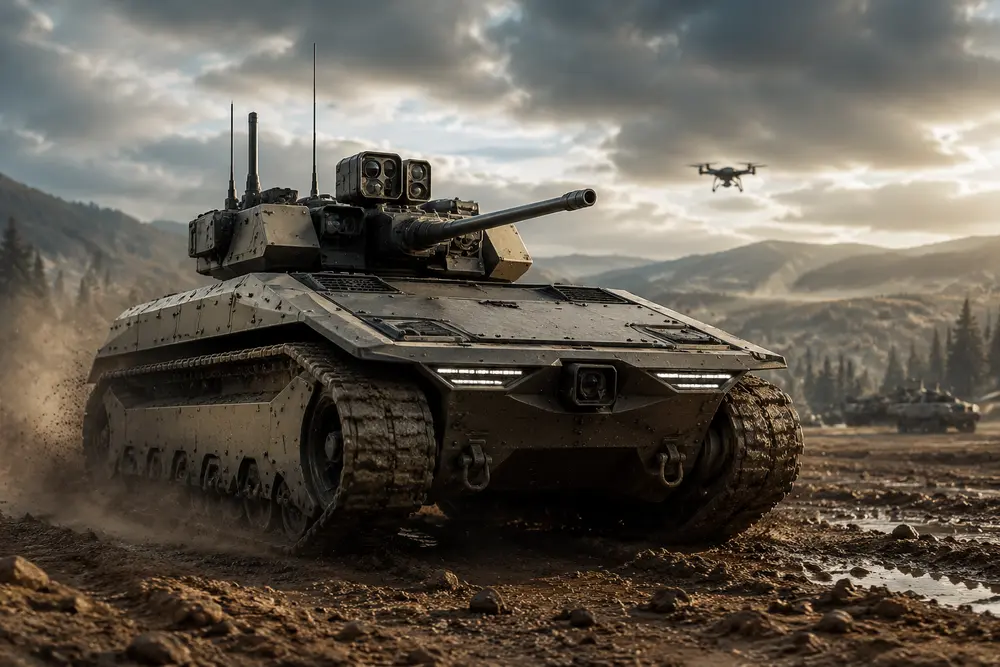
The Ripsaw Tank is one of the most talked-about robotic combat vehicles in the world. It looks like a small tank, moves on tracks, and can carry mission tools, sensors, or weapons. But it is not a normal tank with soldiers inside. It is an uncrewed ground vehicle made to support troops from a safer distance. This machine shows how future battlefields may use robots, smart sensors, and remote control to reduce risk for soldiers.
What Is It?
The Ripsaw Tank is a tracked robotic vehicle built for modern military testing and future combat support. Its design comes from the idea that some jobs are too dangerous for people. A robot vehicle can go first, look ahead, carry tools, and send information back to soldiers. This makes it useful in places with mines, enemy fire, drones, or unknown threats.
The word “tank” is common online because the vehicle has tracks and an armored look. Still, the vehicle is better understood as a robotic combat vehicle. It is made to act like a fast helper, or “wingman,” for human forces. It can support a team without placing a driver, gunner, or commander inside the vehicle.
Who Built It?
The story of the Ripsaw Tank is linked to Howe & Howe, a company known for extreme tracked vehicles. The Howe team helped create fast machines that could cross rough ground with strong power and control. Later, Textron Systems became a key player in the program and helped advance the idea of military robotics.
Textron Systems and Howe & Howe collaborated on the RIPSAW M5 and subsequent models. The family has been tested and improved through work with the U.S. Army, industry partners, and technology teams. This long process changed the vehicle from a bold idea into a serious robotic platform.
Design and Mobility
The Ripsaw Tank uses tracks, so it can move over mud, snow, sand, grass, and broken ground better than many wheeled vehicles. Tracks spread weight over a larger area. This helps the vehicle keep grip and move across uneven land. Speed is also a big part of its identity.
The RIPSAW M5 is listed with a combat weight of 10.5 tons and speed of 40+ mph. It uses a diesel hybrid-electric drivetrain, which can help reduce fuel consumption and noise. Its size and weight make it lighter than many crewed armored vehicles yet strong enough for serious missions.
Sensors and Awareness
This vehicle is not only about armor and tracks. Its real value comes from sensors and control systems. The M5 information sheet lists FLIR 360-degree perception technology, real-time awareness systems, and support for cameras and other mission sensors. This helps the robot see around itself and share data.
Good sensors help soldiers understand what is happening without standing in the danger zone. The vehicle can support reconnaissance, surveillance, and target acquisition. In simple words, it can look, watch, find, and report. This is very important in modern war, where seeing first can mean surviving first.
Payloads and Mission Tools
One major strength of the Ripsaw Tank is its modular design. “Modular” means teams can change parts or payloads based on the mission. The vehicle can use a flatbed, sensors, cameras, communication tools, small drones, or specialized equipment. This makes it more flexible than a single-purpose machine.
The M5 data lists an 8,000 lb payload capacity. It also shows possible mission fits such as medium-caliber weapon systems, anti-aircraft tools, route-clearance equipment, ground-penetrating radar, mine plows, and a smaller “marsupial” ground robot. These options show why the design is built for many roles.
Main Versions
This popular name is often used for the RIPSAW M5, but the family has more than one version. The M5 is the fifth-generation model and became famous for its speed, rugged look, and role in the U.S. Army Robotic Combat Vehicle program. It is a larger and more powerful member of the family.
The RIPSAW M3 is a newer direction. It uses a more modular layout and a common chassis idea. It is designed to support different payloads from a flat-top deck. The M3 has also been connected to the Army RCV program, showing how the family is moving toward flexible robotic systems.
Army Testing and Development
The Ripsaw Tank gained serious attention through the U.S. Army Robotic Combat Vehicle effort. In 2019, the Army worked with industry to move robotic vehicle ideas toward real prototypes. The goal was to test what robots could do for future ground forces, not just talk about future ideas.
In 2021, Textron Systems and Howe & Howe delivered the fourth RIPSAW M5 vehicle to the U.S. Army for the RCV Medium program. The Army planned to use lessons from these vehicles to shape future needs. This shows that the vehicle was not only a display machine; it was part of real military learning.
The M3 and Modern Lessons
The Ripsaw Tank family kept moving after the M5. In 2024, Textron Systems, Howe & Howe, and Teledyne FLIR Defense delivered RIPSAW M3 prototypes for the Army’s robotic combat work. The M3 focused on a modular, open-systems approach and mission flexibility.
This matters because modern war changes fast. A vehicle may need new sensors, drone tools, or counter-drone systems. A closed design can become old quickly. An open and modular design lets engineers add new tools more quickly, which is especially important as threats evolve every year.
How It Could Change Battlefields
The Ripsaw Tank could transform battlefields by shifting dangerous tasks away from humans. It can scout an area before a unit enters. It can carry sensors into a risky zone. It can support troops while they stay farther back. This does not remove soldiers from war, but it may reduce direct risk.
It also changes speed and choice. A commander could send one robotic vehicle to test a route, another to watch a flank, and another to carry tools. This gives human teams more options. The result may be a battlefield in which robots make the first risky move and people make the final decision.
Limits and Challenges
The Ripsaw Tank is advanced, but it is not magic. Robotic vehicles can be costly, need strong communication links, and may face cyber or electronic attack. They also need power, repair, spare parts, and trained operators. In rough war zones, mud, damage, and signal loss can still cause problems.
Drones also create a new challenge. A large robotic vehicle may be seen and attacked by cheaper flying drones. This is why armies must compare cost, protection, and mission value. The best future use may not be one perfect robot, but a balanced mix of humans, drones, and ground robots.
Is It Fully Autonomous?
Many people think this robot drives and fights on its own. In real use, this is more complex. Robotic vehicles can have different levels of remote control, assisted driving, and autonomy. A human operator may still control or approve important actions, especially when weapons are involved.
This is important for safety and trust. Soldiers need to know what the robot sees, where it is going, and what it may do next. The more advanced the software, the more useful the vehicle can be. But trust, control, and rules will remain key parts of military robotics.
Future Outlook
The future of the Ripsaw Tank depends on what armies need next. If future wars need fast robotic scouts, mobile sensor carriers, and support vehicles, this family has a strong place. Its speed, track system, modular deck, and sensor options make it useful for many tests and mission ideas.
Still, the future will also depend on cost, survivability, and battlefield lessons. The vehicle must demonstrate that it can perform jobs better, more safely, or more cheaply than other options. If it succeeds, it may become part of a new style of warfare in which human soldiers work alongside robotic machines.
Conclusion
The Ripsaw Tank is a symbol of how military vehicles are changing. It combines tracks, speed, sensors, payload space, and remote operation in one platform. It is not just a cool-looking machine. It is part of a larger move toward robotic battlefield support.
For readers, the simple idea is this: the Ripsaw Tank is not meant to replace every soldier or every armored vehicle. It is meant to help forces see farther, move smarter, and take fewer risks. That is why this robotic vehicle is changing how people think about future battlefields.
Read More: Tesla Powerwall 3 specs: output power & current configurations
Frequently Asked Questions
1. What is the Ripsaw Tank?
It is a tracked robotic combat vehicle family linked to Textron Systems and Howe & Howe. It is mainly made for military support, testing, and dangerous missions.
2. Is it a real tank?
Not in the normal sense. It looks like a tank, but it is officially closer to an uncrewed ground vehicle or robotic combat vehicle.
3. Who makes it?
It is connected to Howe & Howe and Textron Systems. Newer work also includes partnerships with Teledyne FLIR Defense.
4. How fast can it go?
The RIPSAW M5 is listed at 40+ mph, depending on setup and mission conditions.
5. Why is it important?
It is important because it can help soldiers scout, sense, carry tools, and face danger without putting people inside the vehicle.